
Looking for geography fieldwork options close to school? How about your local regenerative farm?
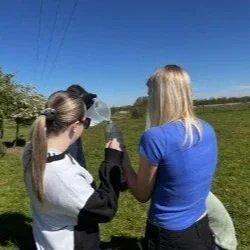
Tristan Leslie at FAI farms and I have been exploring the potential of fieldwork at Northfield Farm, on the Wytham Estate, just outside Oxford, for our local schools. Today, a group of Year 13 geographers and their teachers, from Gosford Hill School, joined us for a day of revision on the carbon and water cycles.
The farm is just 15 minutes by minibus from the school, so they are repeat visitors. The proximity means that they are able to do the trip within the school day, classroom time sacrifice is minimised, and the costs are low. Visiting a local site also helps to deepen the students’ understanding of, and hopefully appreciation for, their local area; repeat visits mean that letters home and risk assessments are easier for the teachers.
This group had already done fieldwork at Wytham Woods, the University of Oxford’s research woodlands, adjacent to the farm. Visiting the farm deepened their understanding of the relevance of carbon and water cycles for food production, gave them the opportunity to learn about the role that regenerative agriculture has to play in the mitigation of and adaptation to climate change, and enabled them to see the real life application of the field techniques they had learned at the Wytham Woods.
We did soil infiltration tests, measured soil temperature, and looked at soil roots and dung beetle presence, in 3 different fields – over grazed and compacted, well managed grazing, and arable. We discussed the relevance for carbon storage, release and sequestration, flooding in Oxford, food production, and biodiversity. We discussed grazing regimes, cover cropping, shallow ploughing, hedgerow management, farm economics and more.
There were also lots of spontaneous opportunities for learning as we walked around the farm: the challenges of cattle farming, invasive species management (mink!), bird migration (the first swallows were overhead), and Tristan’s favourite animal.
As this group are close to leaving school, we also took the opportunity to encourage them to consider the “soft” skills that people need for future jobs and future sustainability. We asked them to take responsibility for their own learning today by leading the discussion with their own curiosity and questions. They responded brilliantly. Their teacher emailed to book in the year 12s before she even left the farm!
Dr Kim Polgreen.