Oxfordshire Schools Sustainability Network event

The Oxfordshire Schools Sustainability Network is for teachers and students from different schools to gather to discuss sustainability issues.

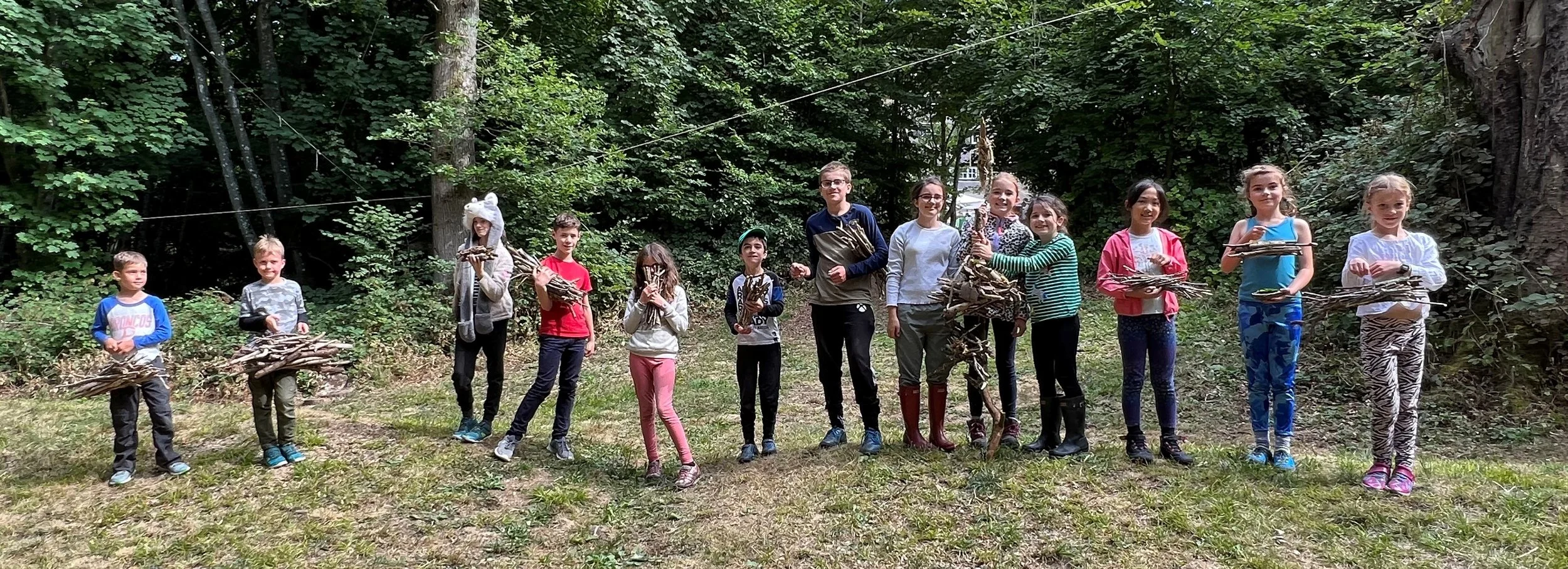
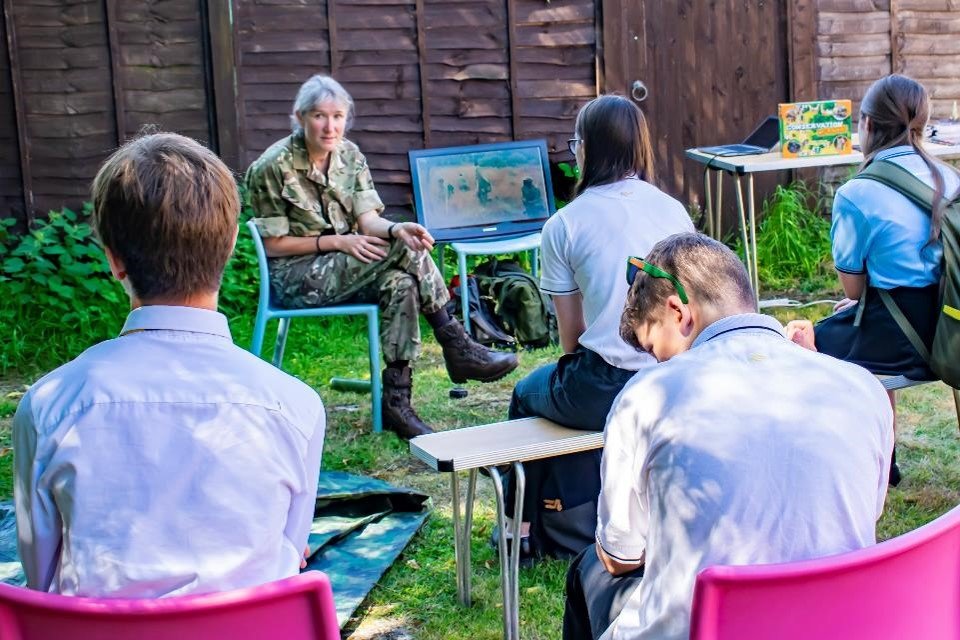
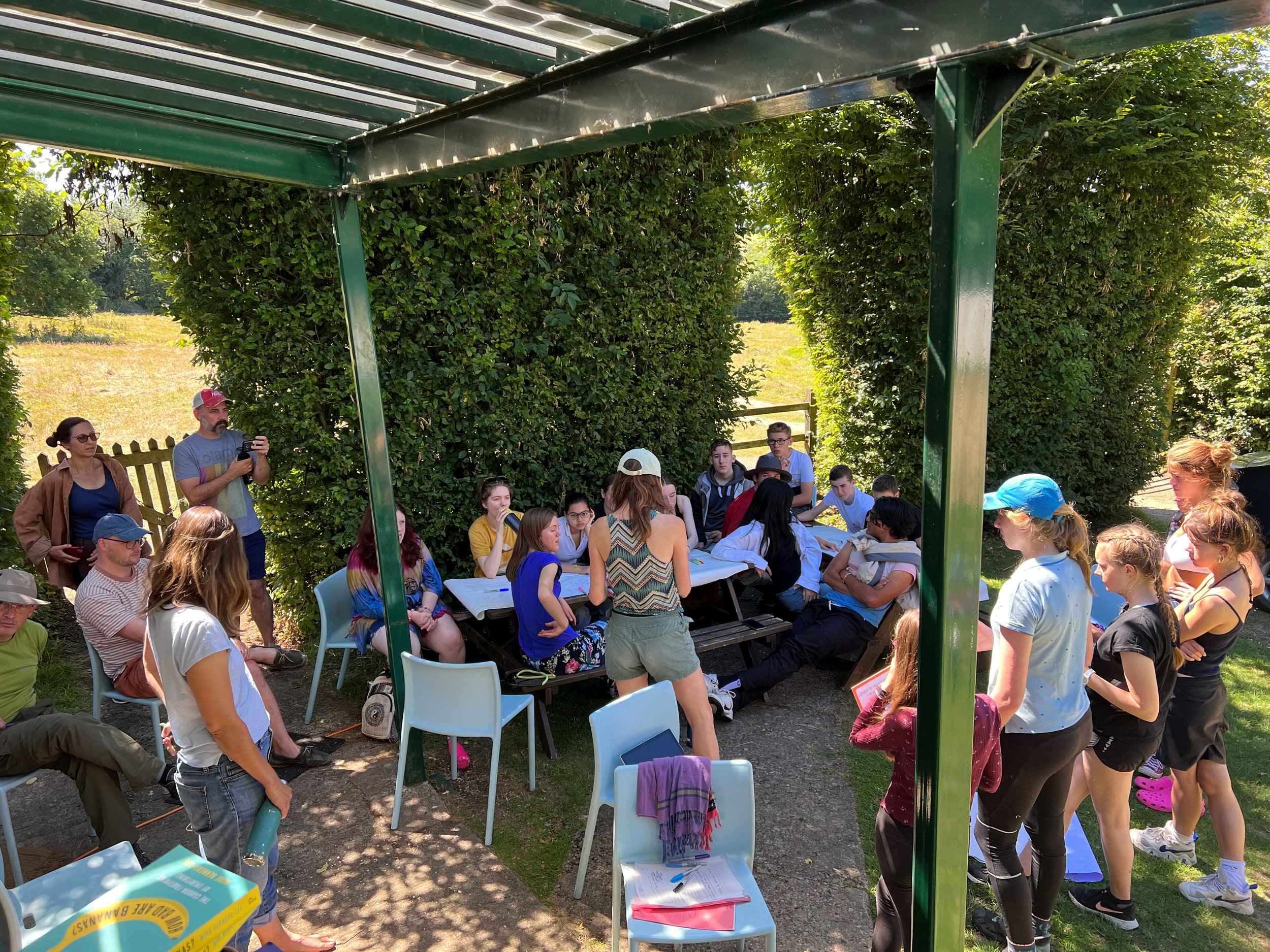
On October 12th, 15 students and 6 teachers gather at the Oxford University School of Geography and Environment for a fantastic session with the Oxford-based Climate Psychologists, Patrick and Megan. Their key take home message was to look after your own wellbeing now while working for a better future.

Students from Cheney School had been previously trained to run a “Climate Cafe”, a lovely activity in which people can share their thoughts and feelings about climate change in a safe space. These students ran a session for the other attending students. Everyone enjoyed it, and the teachers supporting them were moved by what the students had to say.

We were very grateful for the School of Geography and Environment for allowing us to use their fantastic facilities.

The next event will be on December 6th.

Sustainability Education Colloquium with the Oxford University Department of Education

This article appeared on the website of the Oxford University Education Deanery on 11th July 2023 and has been adapted for this website.

In July 2023, I was delighted to have the opportunity to work with Dr Travis Fuchs, and the Oxford Education Deanery, to host a Sustainability Education Colloquium, the first of the Deanery’s suite of teacher learning events for 2023. We convened a group of 25 educators, including 15 teachers from 11 local schools. On a warm Friday evening we met for discussions about climate change and the implications for schools, and a sustainable dinner at St Anne’s College, Oxford.

The following day the group reconvened at the Oxford University research woodland, Wytham Woods, just outside Oxford, where the group discussed why sustainability is so relevant for schools, focusing particularly on (1) the potential benefits of more nature exposure on student (and teacher) wellbeing, and (2) the potential of highlighting the huge growth of sustainability-focussed careers to teenagers, particularly those struggling with the enormity of the implications of the climate and nature crises on their futures.

Our expert witnesses were Professor Ilina Singh, Professor of Neuroscience and Society at the Department of Psychiatry at Oxford University, who shared her expertise on the impact of nature on the wellbeing of humans, and Tim Kruger, a carbon sequestration entrepreneur, and Niall McWilliams, Managing Director of Oxford United Football Club, who both spoke about the world of sustainable work opening up for young people and the importance of preparing them with the relevant knowledge and skills.

Biodiversity experts Dr Liam Crowley and Dr Dani Linton introduced the group to moths and bats respectively, discussing the opportunities for nature connection, and the worrying impacts of climate on biodiversity.

Dr Laura Molway and Dr Hamish Chalmers, co-directors of the Education Deanery, were delighted with the success of the event. “On a weekend that followed the hottest British June on record and five days of the hottest global temperatures ever, this colloquium was timely and starkly relevant.”

High Sheriff of Oxfordshire Award!

Wow! I was shocked to learn that I had been awarded a High Sheriff’s Award for my work at Wytham Woods. It is a huge honour and I feel so humbled that Charlotte Richer, a teacher at The Cherwell School that I have worked with on a number of projects took the time from her ridiculously busy work to put together the application. And then came to the ceremony. Thank you Charlotte! It’s always such a pleasure to work with you. Kim


This is what Charlotte wrote in the application!

Kim works with unfailing energy to share her expertise and enthusiasm about sustainability and the environment with young people. She volunteers her time to facilitate opportunities for young people across Oxfordshire, welcoming groups to Wytham Woods in her role as Youth Educator in Residence, fostering links between researchers and the community and bringing outdoor education into schools. Her purposeful drive and determination inspire others, with projects such as her school tree-planting making a tangible impact not just on the young people directly involved but the wider community too.

What makes Kim’s contribution so unique is the warmth, generosity of spirit and care she brings to every interaction: she inspires those around her to feel empowered to take the lead on issues that matter most to them by taking them seriously, listening thoughtfully and valuing every contribution. From her pastoral wellbeing trips for vulnerable young people to her Green Futures event to inspire students to consider sustainable careers, Kim’s vision and determination to bring community action from concept to realisation is second to none.

Kim inspires others to be their best, promoting new and innovative collaborations between schools and networks, such as her creation of a sustainable fashion project for North Oxford schools with Low Carbon Oxford. That she also finds time to volunteer her expertise to school leadership through a governor role in Oxfordshire state schools, as an advisor to the University and a volunteer with the UK Schools Sustainability Network is further testament to her indefatigable energy and drive.


And this is the lovely write up on the Wytham Woods website -

Wytham Wild Camp Easter 2023

Love the ‘back to basics’ break from hectic life for [my son]. Outdoor, no screen, lovely team around him. And for him to reconnect with friends he met previously. 

Kim you are a legend!! [My daughter] absolutely loved today, she is soooo enjoying your class. It sounds amazing, we heard all about Liam! 

I just wanted to thank you, [my son] absolutely loved the camp today and is begging me to book him in for a summer camp if you are having one!

I was so happy they were immersed in nature and came back with so much to say about their day. Knowing they were with such knowledgeable people was a real plus and it’s clear from the photos this is an authentic camp, like no other.

I really enjoyed how the staff interacted and taught us different things. They were really approachable and enjoyed being asked questions. I particularly liked the camp cooking! My sister Lucy enjoyed the bug hunt, and bug bingo. We both loved Tinker (Kim’s dog).

It was lovely to welcome back so many of our summer Wild Camp crew to Wytham Woods, and to meet our new recruits, this time amongst daffodils and primroses of early spring.

The weather was extraordinarily kind to us, given how cold and wet it had been right up to the day before. We had lovely sunshine for our first two days, and enough action to keep us warm on day 3.

MONDAY was led by Manse Ahmed from Wilderness Pioneers. Manse is an amazing survivalist, in high demand for his skills. He runs some fantastic courses. Check out his website. Here he is showing the group edible plants, and pointing out badger tracks, as we rambled around the Woods on Monday morning.

Nettles, primroses and dog violets - yum!

Badger and deer tracks - cool!

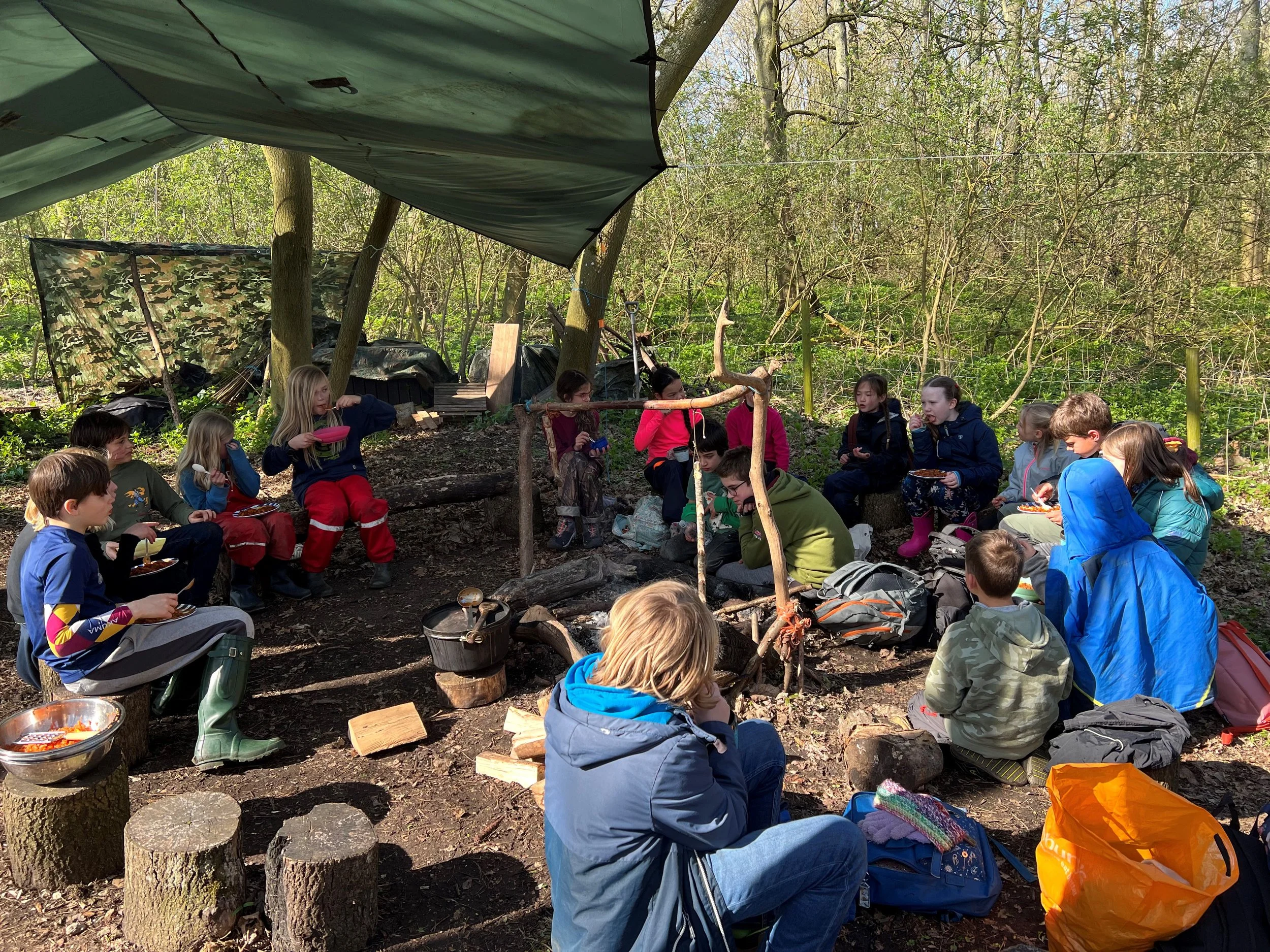
Back at base camp the kids made themselves at home in and under trees, putting up their own tarpaulin shelters, clearly remembering Manse’s lessons from last summer.

While various battles ensued between encampments, they dipped in and out of the food prep activity, chopping and grating a mountain for veg to make our signature veg stew for afternoon tea. It was a great opportunity to learn how to safely use a knife, and the best techniques for peeling and chopping onions, garlic, carrots, sweet potato, mushrooms. The stew simmered away over the fire in Manse’s huge pot for a couple of hours and ended up deliciously soft and tasty. It was devoured by kids and staff alike!

The afternoon was wiled away in the sunshine, amongst the spring flowers. The games ebbed and flowed; we intervened with helpful ideas when tensions rose, or stepped in to divert them from danger, but mostly they managed themselves with us keeping a close eye on them, and Manse helping with den building. 5pm crept up on us without anyone noticing.


TUESDAY was bug day! It was led by Katie who works on education outreach for the Darwin Tree of Life Project (DToL) in the Department of Biology at Oxford University. Katie works with Dr Liam Crowley, an amazing entomologist who is the invertebrate expert on the Wytham DToL project, and a brilliant educator himself. Liam spent the day with us, sharing his enthusiasm and expertise.

Katie had set up three moth traps the evening before - seeing and holding moths is a fantastic way to introduce people (of any age) to wildlife. The kids loved them, wearing them on their arms and faces!

The other fabulous activities that Katie organised were looking at invertebrates under the microscopes up in the lab which everyone enjoyed, bug bingo with Liam’s gory and fascinating factoids about all the insects featured, and a long ramble through the Woods with bug nets, which this time featured a mud slide!

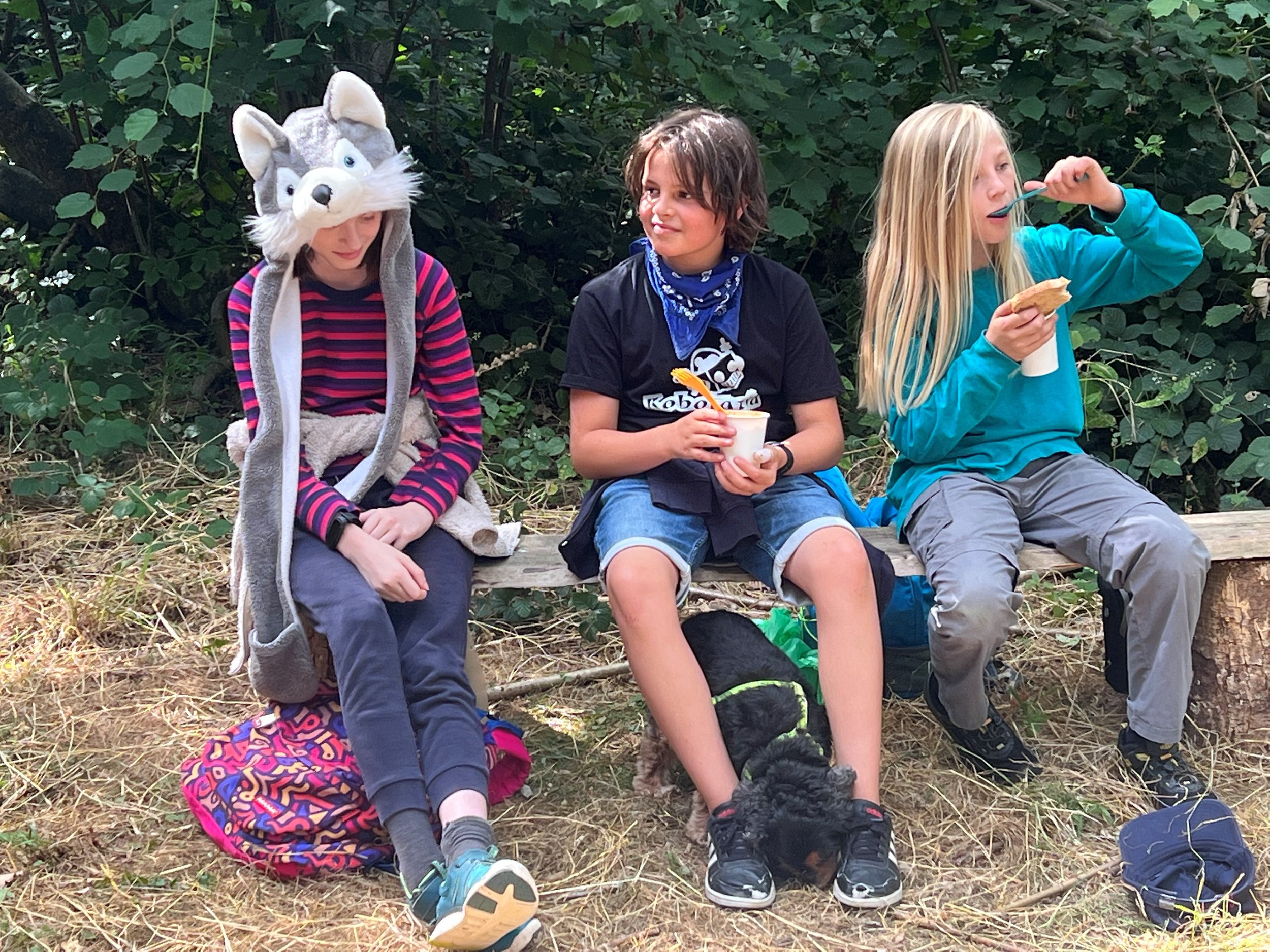
Playing bug bingo while wearing some moths.

The results of the bug walk

Playing Bug Bingo with Liam

Playing in the straw under the parachute

And hanging out under the trees


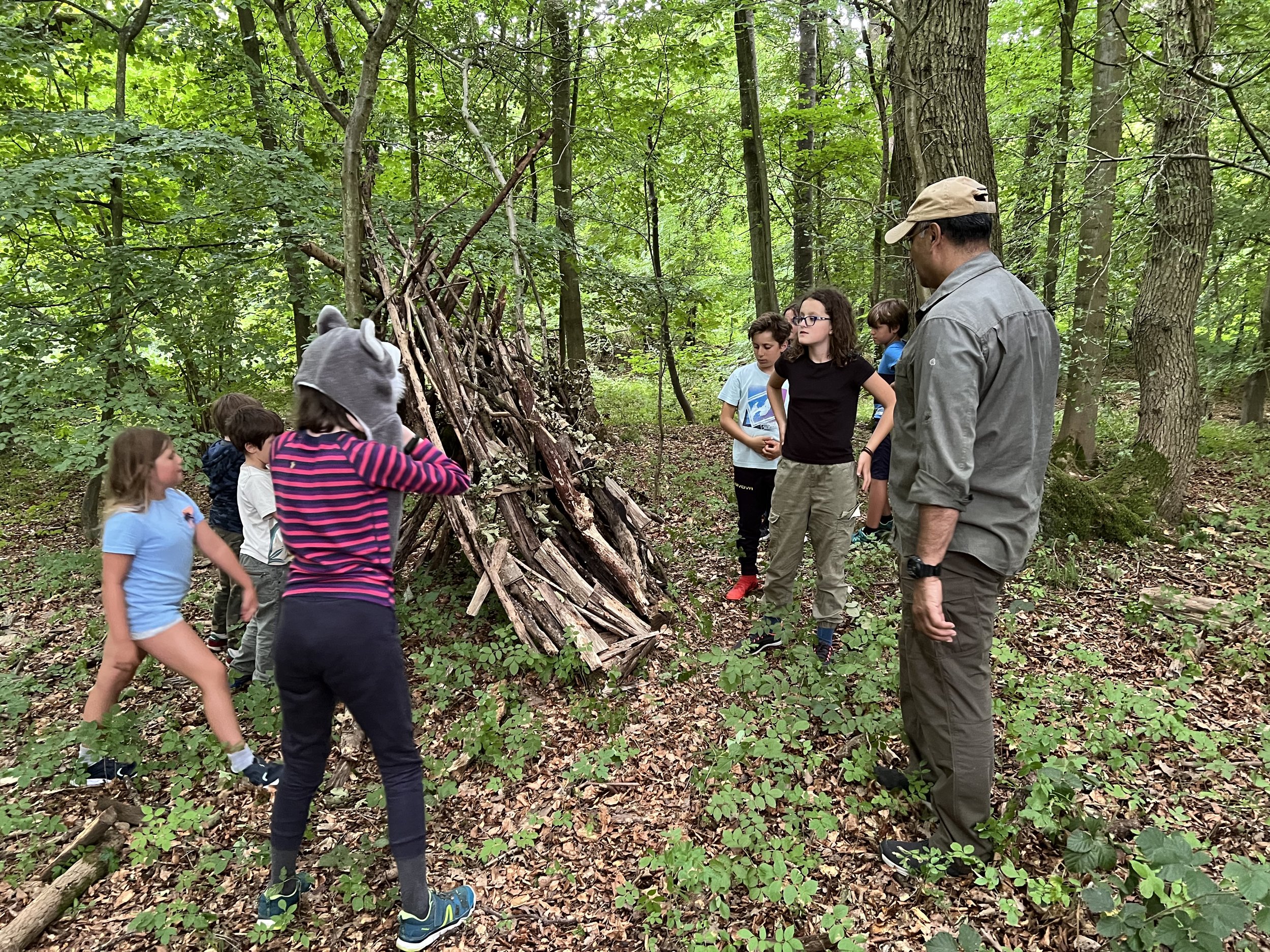
WEDNESDAY was led by school teacher and bushcraft expert Charlie Montier who runs Oxford Adventure School - check out his lovely paddle boarding adventures. We started the day with a walk up the hill to warm up, and a fantastic shelter building lesson, complete with Charlie’s jungle stories about swarming ants and jaguars!

Back at base, Charlie taught the group how to light a fire using a steel and cotton wool, and keep it going until it is established. This was a fantastic life lesson in tenacity, team work, learning from failure, and the joy of success. Success meant the chance to cook some bread on a stick, and warm a frankfurter and cheese over your fire, as well as the glow of achievement after a long struggle!

After a late lunch and expeditions to the loo and for more water, Charlie taught the group to whittle safely, and to use tools safely. This was clearly so empowering. The whittling circle also got involved in some deep political discussions - I was impressed!

Whittling and chatting

They loved it all - it was hard to drag them away at 4.45! But team work prevailed and we were packed up and back in the car park with happy parents at 5pm.


Many thanks to our amazing team, Katie, Manse, Zoe, Liam and Charlie, for all their amazing work and inspiration.

Manse, Zoe and Katie.

Charlie.

Me.

We are now planning another camp for Spring Half Term and for the summer holidays. Email me on kim.polgreen@admin.ox.ac.uk if you’d like to get on the mailing list for those.

First book group of 2023 at Wytham Woods

Another lovely walk and talk at Wytham. We covered loads of books and ideas. Not much else to say really. Next one is March 12th - on Eventbrite on the Wytham Woods account. This was our list for today - added to the main list.

Peter Ackroyd - chapter Sacred River

Lucy Jones - Losing Eden

Sue Stuart-Smith - The Well Gardened Mind

Wing in the Willows (as an adult)

Rewilding - Isabella Tree

Fledging - Hannah Boyrnw-Taylor (raises a finch, then a swift)

Regenesis - George Monbiot

HE Bates - Through the Woods

Thunderstone - Nancy Campbell

Archibald Lampman (Canadian poet) - January Morning

Book group members at Wytham Woods

Planting hedges at The Cherwell School

On Wednesday I spent the day at The Cherwell School with a group of wonderful Y13 students who were ducking in and out of other commitments such as Oxbridge interviews, to lead a day of hedge plantings with the Y7s. It was fascinating to see the Y13s chatting away with Y7s - something they probably don’t normally have the opportunity to do. I’m sure that both groups benefited hugely from understanding a bit more about the other.

Everyone hard at work

Year 7 carefully cleaning the spades - without even being asked.

Our wonderful St Edward’s student team came to help as part of their volunteering project

Imagine what it will be like in a few years when the fence has been obscured and the spiral guards have been removed.

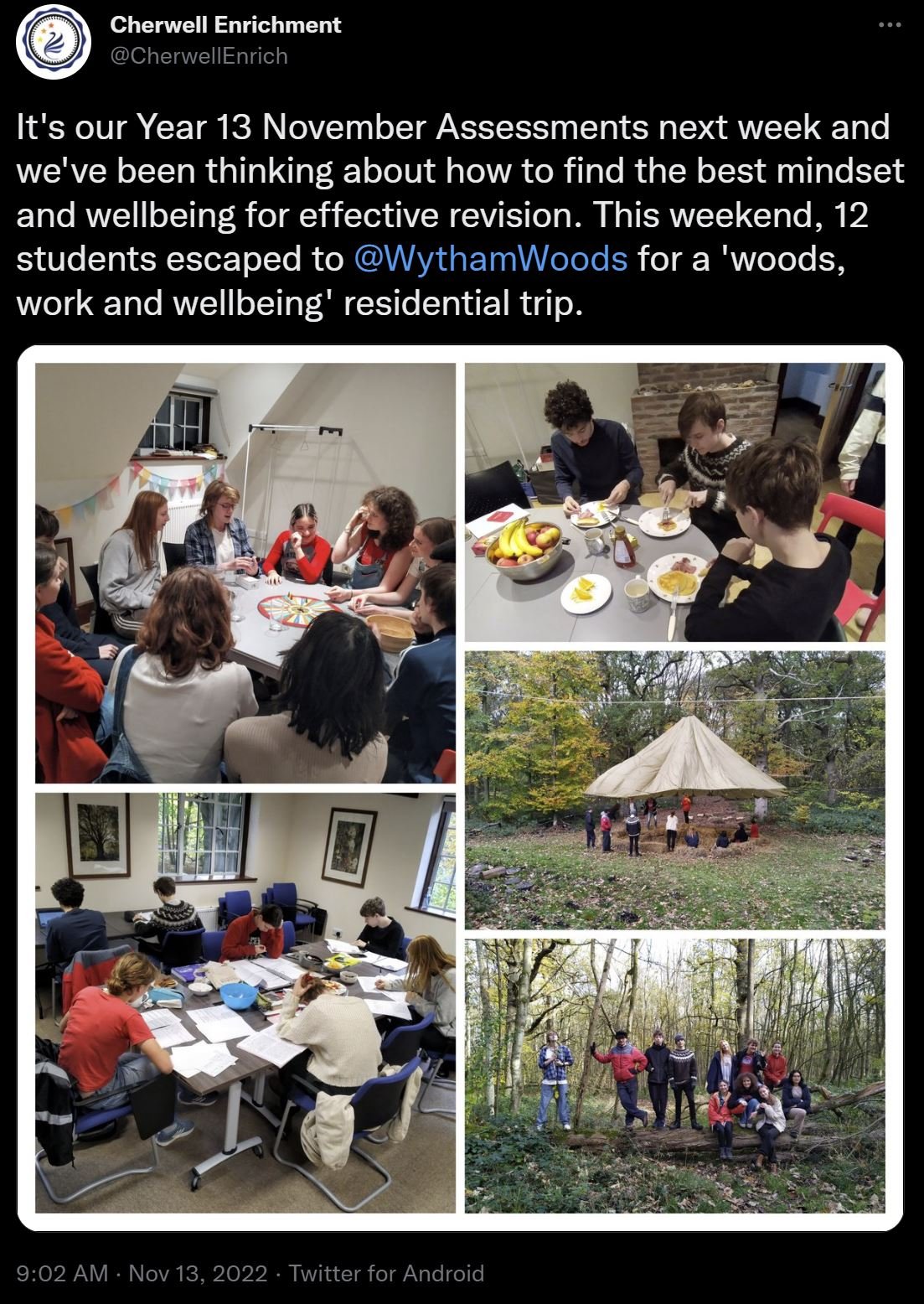
Revising in the Woods

Cheney students help with planting the ffennell avenue

Our brilliant Cheney School year 11 work experience group: they walked for miles, planted trees, got soaked in the rain, reviewed the new installations at the Museum of Natural History, helped out with a project at another schools, and learned about bird research, all in 4 days. And what’s more they were polite, fun, willing to engage, happy to learn and generally typically wonderful teenagers. Thanks guys! Really enjoyed your company.

If you want to do work experience at Wytham, please email kim.polgreen@admin.ox.ac.uk and we will see if we can help you. We take groups of students - from 6 - 8 at once. The hours are 10am - 2pm (sometimes 2.30pm), Monday to Thursday. We find that these hours are plenty, given that students have to travel to and from the Woods, and it can be tiring with quite a lot of walking, and some physical work.

A Wonderful Wytham Women’s Weekend

We had a wonderful Wytham Women’s Weekend at Wytham Woods! The sun shone, and the trees were in glorious autumn colours. We walked and talked and cooked and ate and did some art.

I treasure my memories of this weekend: the trees, the way time unfolded around us, how the woods themselves took us in and wrapped us away from the outside world.
— Miranda
Lovely relaxing experience with like-minded woman, in the wonderful surroundings of Wytham Woods.
— Donna
It was a real treat to spend the weekend with a group of like-minded women in a beautiful setting. A great mix of activities (I especially enjoyed cooking together on Saturday evening) which still left time to chill or chat. Thank you Kim!
— Leonie

Printing workshop

Lovely feedback from our work experience students

When you get a lovely surprise thank you email from a group of students, it’s a very good feeling that you are getting something right.

“Dearest Kim,

Thank you for the opportunities you gave us for the MAD week, we thoroughly enjoyed each day. The experience was amazing, and we all agree we would do it again in a heartbeat, as the time we spent with both you and Tinker was awesome, educational, and above all fun.

I know that we love Tinker and were very vocal about it during the week, but it also extends to you, thank you so much for being a such an incredible guide, the snacks and the food were delicious, and the activities we did were calm and relaxing especially under the Forrest setting. 

The staff and scientists there were super nice, and it was great opportunity to meet them, and it has persuaded some of us to look for a career similar to the ones at Wytham Woods.

We particularly enjoyed the session at the end of Tuesday with the microscopes, Infra-red, and 3D scanners. Playing around with the new technology was incredible and a welcome change to our school’s tech which only works once a blue moon. We hope your research goes amazingly in the future and thank you so much for everything.

From 

Lara, Flo, Archie, Stefan, and Elliott

P.S were really sorry we couldn’t get this to you sooner, our school emails were having problems and wouldn’t send anything since we broke up from school.”

Wytham Wild Camp for 9ish to 11ish year olds

Wow! Manse and I are exhausted!!! 16 kids per day for 5 days is a lot! But well worth it. The children were creative, funny, curious, tenacious, cooperative, kind and just all round brilliant. And we’ve had some lovely feedback from parents -

“Thank so much for organising this and giving the kids such a wonderful time. Emil and Noah loved it.  Hope you keep doing this!

“Thank you so much for putting on this truly wonderful experience. I'm very envious of the children! Laurence and Frankie learned so much.” 

“Thanks for the lovely pictures! Mimi had a great time and might well be up for doing it again. Hope you will now be able to enjoy a well-earned rest...”

“What a wonderful blog - thank you so much. Our boys had such a brilliant time - you can see how you captured their interest in the lovely photos. They would love to come back!”

“Thank you so much for this message and wonderful illustrated report of the week! It was such a special week and we feel really privileged to have been a part of it. Thank you for making it such a stimulating and interesting adventure.  Ambrose has referred to it a number of times since and we are sure it will stay with him for a long while and of course many of the skills, forever.”

Young botanist

The beginning of the week seems a long time ago now. This is what we did -

On Monday we walked just a short way into the Woods, but quickly found ourselves in a secret hideout, complete with camp fire pit. The kids loved the secluded, safe feel. That morning was all about food and cooking. We got them chopping veg for a veggie stew (with a bit of first aid training for good measure!) which they they wolfed for afternoon tea with lots of grated cheese and slices of bread to dunk. While waiting for it to cook we went for a long ramble through the Woods where they learned to identify some edible plants, the names of trees and plants, and made an obstacle course from the hay bales behind the Chalet, before returning to “camp”.

Mint!

A watched pot….

Tinker tidying up dropped cheese


Tuesday was navigation and shelter building day. Manse taught the group some basic navigation skills using the Wytham map and some compasses. The kids then used their skills to navigate us round cool paths in the Great Wood. Following the example of Raymond ffennell who first brought children to the Woods for restorative fun in the 1920s, we instigated quiet time after lunch which worked brilliantly. The afternoon involved building dens, putting up shelters, and fire lighting with flint and steel.


On Wednesday we set off on an expedition all the way across the Woods. It took us all day. We spent ages at the lovely area of beech trees at the top of the hill, playing around the large den that previous children have created, Manse and I hovering close by as they climbed the accommodating beech trees, calling out any behaviour that worried us, annoying those who fancied their climbing skills more than we did! We finally moved on, practicing navigation skills, over the brow of the hill, plunging into the cool, verdant, deep woodland on the far side. We stopped for lunch at my favourite clearing, finding crickets and eating blackberries, and then wandered on, via the pond to spot dragon flies, onto Sunday’s Hill. After a couple of hours of wild games, we finally trudged home via Manse’s strategically placed water station, and a last play at the den at the Dell, before saying hello to the sheep and heading back down the hill to the car park.

The BEST blackberries - in a secret location

Who wants to run around when you can relax in Manse’s hammock?


Thursday was very exciting as we were joined by Dr Liam Crowley, one of the world’s best entomologists, and fantastic teacher. Liam showed the group all sorts of ways to find bugs, and told us all about them.

Sieving leaf litter onto a sheet

We are going to catch a big one….


On Friday Liam had set a moth trap for us so we spent ages looking at them all, potting them up, and identifying them. The kids then drew them as accurately as possible to see if Liam could recognise them from their drawings - the drawings and Liam were very good! After another ramble through Great Wood where we found many more invertebrates, we collected twigs from the piles made during recent tree felling, to make bug houses to take home. We found time for more tree ID, taught this time by the children who had been with us at the start of the week, some leaf rubbings, and some games.

Bug houses, and at least one luxury hotel.

It was such a pleasure to see the children engaged in what they were seeing and learning. I also love those moments when I interact with one who is being a bit over the top, or needing a bit of TLC, looking into uncertain faces, and finding a way to restore certainty and a sense of calm. We have that privilege on a small summer camp that bigger groups (and school teachers) can’t achieve. Kids are fantastic in small numbers! All education should be like this.

Many thanks to all the lovely parents who we met dropping off and picking up who appreciated what we created for their children. We really enjoyed meeting you.

ECI Summer School 2022 at Wytham Woods

“Thanks so much for the wonderful experience for Kate and the others. She really loved her time there!! If you had any pictures, Kate was sad she didn’t really take any of the group and would love some! Though she does have lots of cute moth and bat pictures🥰 Thanks so much for all your hard work!!”

Each year I run a summer school on behalf of the Environmental Change Institute at Oxford University. Having had to cancel in 2020 due to Covid, in 2021 we moved it to Wytham Woods, and camped, due to continuing Covid restrictions. This year, we decided to stay at Wytham, and use the lovely little dorm rooms in the Chalet. The combination of comfort and wilderness was perfect.

We had twelve students staying for three days. They explored the woods, discussed climate science, climate impacts and climate solutions, talked about nature based solutions and regenerative agriculture, met and talked to University researchers, went up the canopy walkway, cooked together, sat round camp fires and played games, discussed climate and ecology with two expert teachers, did some nature art, and worked with a DPhil student on a theatre production, went badger watching, saw bats up close.

We asked them what they liked about the course and this is what they said:

“The activities we did were fun and educational…. The timetable was good and had enough time to do everything…. I like the kitchen area…. The talks were interesting…. Bonfires…. Activities where we learned a lot about climate change etc… Theatre activity and art activities…. Good food…. Card games…. Seeing pretty moths…. Walk with friends…. The showers were very good…. Substantial amount of food…. Power naps…. Happy leaders…. Badgers were great meditation…. The art was fun…. Tiye was very good as she was our age…. Knowledge given…. Research projects…. Theatre…. Bonfire…. Food was nice…. Good number of people…. I learned a lot of new stuff…. Chalet was nice…. Sitting around fire pit…. Seeing bats…. Art part…. Fun to learn about identifying plants…. I got to experience what PhD research is like…. The speakers covered a range of different topics in the environmental sector…. Time to regroup and relax…. Learned a lot…. Really nice set up of the chalet - communal…. It’s nice to have quite a small group so that you can get to know each other…. Bats!… Moths!… Morning walk…. Camp fire….”

They also have us some great ideas about how we could improve it for next time. Main take home is that we need to help our experts be more interactive - it’s always a challenge for young researchers to step into education. And they wanted more time to explore the Woods by themselves - one full afternoon was not enough!

I learn more each year about how to teach young people about nature and climate. But actually as the situation gets more serious, it gets harder. I am trying to strike a balance between them having a good time and enjoying the Woods, while learning about what is happening to them because of Climate Change.

Huge thanks to my friend Jeni for working with me - we’ve been working together for nearly 20 years on summer camps! To Martyn Steiner who came up each day to help with the discussions and who put on an impromptu lesson on the last morning. To Charlotte Schofield who came up and inspired us about doing art in the Woods. To Tiye (year 12) who has become an expert in regenerative agriculture since she decided to look at it for her EPQ last year, and who came out to Wytham on her way to London to talk to us about what she knows and was totally brilliant. To Dr Curt Lamberth who we bumped into and happily found 20 minutes to take the group up the canopy walkway. To Dr Phil Grunewald who cycled all the way up the hill to talk to us about energy systems. To Dr Tanesha Allen who always delights us with badger research stories. To Sara Middleton whose enthusiasm for and love of plants fired us all with enthusiasm. To Nigel and the Wytham team for supporting us. And to the ECI for continuing to support this initiative.

Next year’s course will be 25th - 27th July, again at Wytham Woods.


Green Futures Conference

Well that went well! All the months of hard work preparing this event paid off. We had 175 students from around 12 schools across Oxfordshire, and 10 lovely exhibitors who ran 4 consecutive workshops for groups of around 15 students per workshop. The beautiful Hill End Outdoor Education Centre provided the perfect backdrop, and plenty of shade in the near 30 degree heat!

Student played energy networks with Low Carbon Hub, took pallets apart and learned about the recycling sector with Oxford Wood Recycling, designed low energy houses with Beard Construction, planned some ecology restoration with Amey Consulting, discovered the role of the armed forces in environmental protection, talked about regenerative farming with the coolest farmer in town, explored alternatives fuels with Siemens Energy, discussed land management with Strutt and Parker and Wytham Woods in tandem, and found out what Universities are doing about nature protection.

The indomitable Ian Curtis from the Environment Change Institute at Oxford University, as well as taking photos all day, gave a rousing plenary under the silver birches in the peak of the heat, encouraging the students to become part of the green economy in service of their own futures.

Here is a lovely blog about the event by Skye from Low Carbon Hub: Green Futures Conference at Hill End - Low Carbon Hub

In response to feedback from students, teachers and employers we are making a few tweaks for next time, and thinking about doing another on this coming autumn. Watch this space.

Oxford High Year 12 fieldwork at Wytham Woods

“We had a fantastic, immersive and inspiring field trip to Wytham Woods! We started the day by looking at a huge variety of moth species that had been enticed into the moth trap overnight. We were very fortunate to be joined by Dr Liam Crowley, who shared his expert knowledge of each species and their fascinating adaptations. Our students really enjoyed being able to have an up close look at each moth and some even got to hold the lobster moth! We also got to see the most famous moth of all, the peppered moth! After this we ventured into the meadow to carry out our first sampling technique using sweep nets. Our students were simply amazed by the number and variety of invertebrates they were able to catch and had a lot of fun trying to identify them. Later on, we ventured into another area of the woods and used belt transects and quadrats to identify a variety of plant species and measure a range of abiotic factors. Following this, we conducted a flower-insect timed count to monitor the activity of pollinators.

Overall, we had a brilliant day in the most beautiful setting and an ecological experience that extended far beyond the scope of the A-level specification! Our students left feeling completely inspired and cannot wait to return next week to conduct their own independent ecological research projects. Thank you so much to Kim and Liam for their expert guidance and for making the day possible. We are so lucky to have such a unique and wonderful place on our doorstep and would highly recommend Wytham Woods as a school field trip destination.”

Oxford High School, 2022.

Well Hellooo there. I’m a Lobster Moth

Anyone for pepper(ed moth)?

Business and sustainability workshop with Economics and Management undergraduates

It was a such an interesting experience to spend a day at Wytham Woods with a group of Economics and Management undergraduates from Pembroke College, Oxford University, discussing business and sustainability.

We started the day with a walk and talk with Conservator Nigel Fisher, discussing the ecological research that takes place at Wytham and the implications for different business sectors. We discussed the impacts of tree disease on the timber trade, implications of the lack of biosecurity on future plant diseases, the effects of soil degradation on global agricultural yields, the impacts of tree loss on flooding, and the risks of losing pollinators for agriculture and biodiversity.

Up at the Chalet (the research station at the heart of the Woods), we continued the conversations with a workshop looking at the risks and opportunities for different business sectors. We discussed coffee, steel, fashion, tourism and consumer electronics. Once you get talking about it it’s amazing how you can see that the links between the natural “economy” and the human economy are everywhere.

These were the prompt cards they worked from -

Coffee

What would you advise a large coffee brand to do over the next 5 years?

·       Small-scale farmers produce about 70 percent of the world’s coffee, and as many as 120 million people depend directly or indirectly on coffee production for their economic survival

·       Water stress and increased temperatures reduce quality and yield.

·       Coffee rust disease and the borer beetle are spreading faster because of climate change.

·       Coffee production is linked to deforestation

·       The coffee required for one single cup of coffee takes 140 liters of water to produce.

·       Waste coffee grounds create methane

 Environmental Effects of Coffee Production (theworldcounts.com)

Why Biodiversity Matters to Your Daily Cup of Coffee: Preserving the Birthplace of Wild Arabica Coffee in Ethiopia’s Highlands (worldbank.org)

Steel

What would you advise an investor in the steel sector?

·       Steel production is highly energy intensive and polluting in mining and production stages.

·       It is used mainly in construction.

·       a Korean company has developed a steelmaking method that emits 90 percent less toxic emissions than traditional methods

Steel production & environmental impact (greenspec.co.uk)

https://www.theworldcounts.com/challenges/planet-earth/mining/environmental-impact-of-steel-production/story

Consumer electronics

What would you advise a large consumer electronics brand to do over the next 3 years?

·       Humans generate 50Mn tonnes electronic waste per year. Only 20% is recycled.

·       Mining for metals has a huge impact on biodiverse regions.

·       E-waste materials are valued at $60Bln.

 Consumption patterns and biodiversity | Royal Society

Fashion

What would you advise a major fashion brand to do over the next 2 years?

·       The textiles and fashion industry produced around 10% of global greenhouse gases and causes around 20% of industrial pollution of water, and accounts for 10% of global pesticide use.

·       30% of cellulose fibre comes from endangered and primary forests.

·       Plastic microfibres have been found everywhere, including in human blood.

·       Only 12% is recycled.

Biodiversity: The next frontier in sustainable fashion | McKinsey

What Is Biodiversity And How Does It Connect With Fashion? | British Vogue

Tourism

What would you advise a major travel brand to do over the next 2 years?

·       Tourism has a negative impact on biodiversity and climate change – 8% of carbon emissions and damage to biodiverse areas e.g. galapagos

·       Tourism can bring income which can help preserve biodiversity

·       Some tourism does not contribute to the local economy

Tourism responsible for 8% of global greenhouse gas emissions, study finds - Carbon Brief

Tourism can help sustain biodiversity (unep.org)

A walk back along some of the less trodden paths in the Woods completed a very satisfying day for all of us.

Recommendations from the May book group